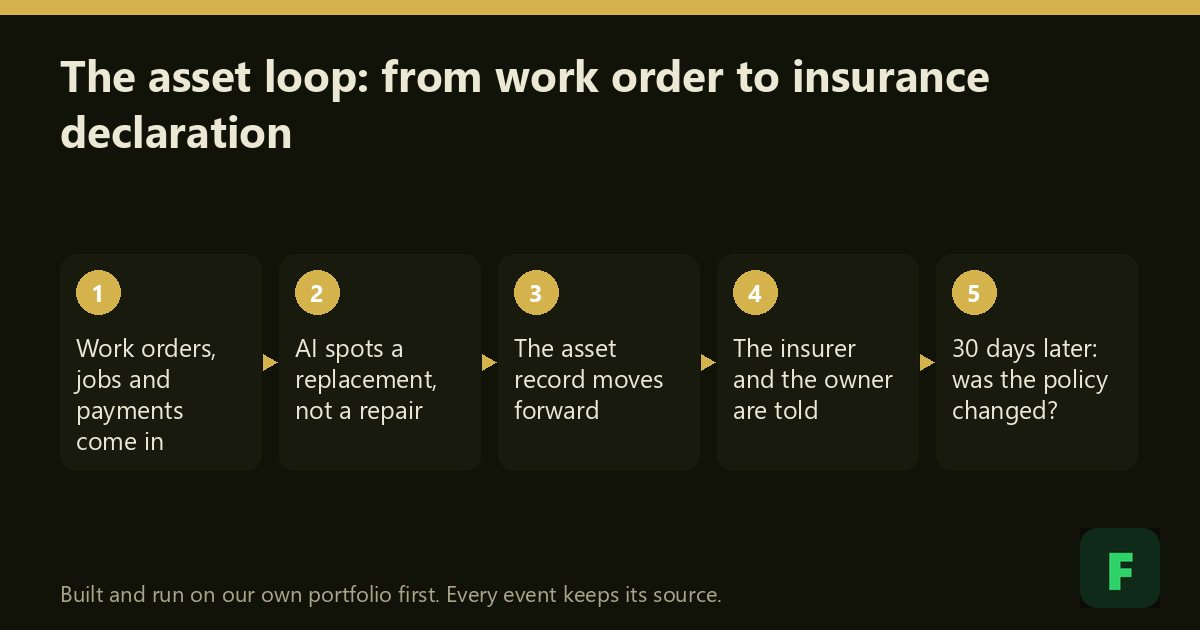
This month I pulled the insurance declarations on the houses I own personally and laid them next to what we know about those houses. Every one of them carried a roof year that was older than the real roof, by anywhere from 4 to 26 years. Several were Actual Cash Value policies, which means a claim is paid on the depreciated value of the roof the insurer thinks is there. A new roof was being insured, and would have been paid, as an old one.
Nobody did anything wrong. The roofer did the job, the invoice got paid, the work order got closed. The insurer simply never heard about it, because nothing in the chain was built to notice that a house had changed.
The data was already there
A property manager sees every replacement on every house. It is in three places most of us already have:
- Work orders. "Replace furnace", "new water heater", "panel upgrade". Ours are in PropertyMeld.
- Contractor jobs. A roof is a job with a budget and labour lines. Ours are in JobTread.
- Payments. The cheque to the roofer is the most reliable record of all, because nobody pays for a roof that did not happen.
What none of those systems has is a house: one record per property that says the roof is from 2024, the panel from 2019, the furnace from 2021, and here is where each of those facts came from.
What the AI actually does
This is the part people over-sell, so I will be specific. The AI is not deciding anything clever. It reads text that humans wrote in a hurry and sorts it:
- Replacement or repair? "Patched flashing" is a repair. "Tear-off and re-shingle" is a replacement. Only replacements move a house's record.
- Which house? Matched on the property's id, never on a typed address.
- Is it the same event twice? A roof shows up as a job, then an invoice, then a payment. One roof is reported once.
- Do we trust the source? Some vendors' notes are reliable and some are not. Untrusted events are recorded on the house but never sent to anyone.
Then the boring part does the real work. Each week the new events go to the insurance agent in one email per agent, grouped by house. Thirty days later the system checks whether the agent confirmed the change, and anything still open lands on one digest instead of being forgotten. The first run found 39 updates across two agents on my own houses alone.
The owner alert is the part that sells
For a management company, the same loop is worth more pointed at the owner than at your own policy. When we replace a roof, a furnace or a panel on an owner's rental, the owner should hear about it in terms of money:
- A newer roof or system can change the premium. Many carriers price on roof age and on the age of electrical and heating systems.
- It changes what a claim pays. On an Actual Cash Value policy, a roof recorded as 20 years old is paid like one.
- It is evidence. The owner has the date, the invoice and the work order in one place when an adjuster asks.
So the alert goes to the owner with a short note they can forward to their agent, and a per-property summary of insurance-relevant work rides along with the year-end statement. It costs us nothing to send. It is the kind of thing an owner remembers at renewal time, and it is the opposite of the only other reason a manager usually calls about a roof, which is to ask for money.
Why this is a board, not a report
The mistake would be to build this as a once-a-year spreadsheet. The value is that the record is always current: every week's work moves it forward, every event keeps its source, and nothing reaches an insurer or an owner that a person could not trace back to an invoice. That is the same rule every FieldVine board follows. A board holds the whole population; the alert is just a view of what changed.
We built this for our own book first, which is how everything in FieldVine starts. If you manage doors and want your asset records, insurance and owner alerts to keep themselves current, email me. I will show you the loop running on real houses.